


Next: Examples Up: Declarative Loops and List Previous: Examples Contents Index
foreach(orin
,
,
in
,
,
,
)
foreach(where
is an accumulator or a list of accumulators. The ordering of and is not important since the types are checked at runtime.
One form of an accumulator is ac , where
  is a variable and
  is the initial value for the accumulator before the loop starts. In , recurrences can be used to specify how the value of the accumulator in the previous iteration, denoted as
 ^0, is related to the value of the accumulator in the current iteration, denoted as ^1. Let's use
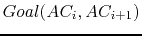 to denote an instance of in which
 ^0 is replaced with a new variable  ,
, ^1 is replaced with another new variable  , and all local variables are renamed. Assume that the loop stops after
  iterations. Then this foreach means the following sequence of goals:
=
,
,
,
